
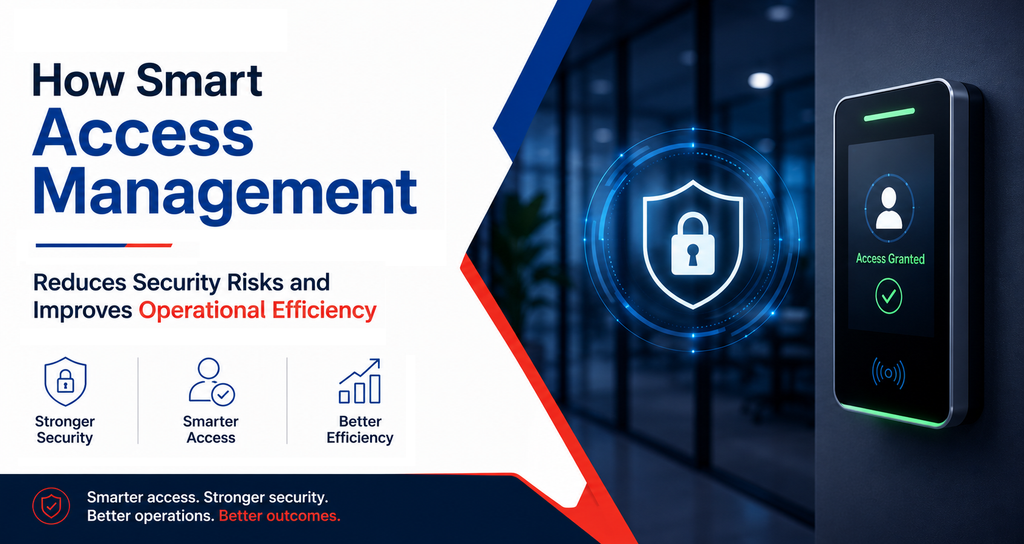
Security and operational efficiency are two of the most important priorities for modern organisations. Offices, manufacturing facilities, warehouses, hospitals, educational institutions, residential communities, and commercial buildings need to control who can enter their premises while ensuring that authorised employees and visitors can move efficiently.
Traditional access methods such as physical keys, access cards, and manual visitor
registers can create security gaps and operational challenges. Lost cards, unauthorized entry, outdated access permissions, and limited visibility into movement can make it difficult for organizations to maintain effective security.
This is where Smart Access Management can make a significant difference.
Smart Access Management is a technology-driven approach to controlling, monitoring and managing access to physical facilities using intelligent security technologies,centralized controls, and real-time information. It helps organizations improve security, simplify access administration, and create better visibility across their facilities.
For businesses looking to strengthen physical security while improving operational
efficiency, a smart access control system can become an important part of their
overall security infrastructure.
What Is Smart Access Management?
Smart Access Management refers to the use of modern technologies to manage access to buildings, facilities, restricted areas and other physical locations.
Depending on the organization’s requirements, a smart access management solution can integrate technologies such as:
- Access control systems
- Smart security terminals
- RFID and access cards
- Biometric authentication
- Mobile-based access
- Visitor management
- Centralized security consoles
- Real-time monitoring
- Automated alerts
- Access logs and reports
Instead of relying entirely on manual processes, organizations can use intelligent
access management to automate access decisions and monitor activity across their
facilities.
How Does Smart Access Management Reduce Security Risks?
1. Prevents Unauthorized Access
One of the primary benefits of smart access management is controlling who can enter a facility or restricted area.
Traditional keys can be copied or lost, while access cards can be misplaced or shared. A smart access control system can use authentication methods such as biometrics, credentials, mobile devices, or access cards to verify users.
Organizations can define access permissions based on employees, departments, roles, locations and time periods.
This makes it easier to ensure that only authorized individuals can access sensitive
areas.
2. Provides Real-Time Access Visibility
Security teams need to know what is happening inside their facilities.
A modern access management solution can provide real-time information about
access events, including successful entries, denied attempts, and other relevant
activities.
This visibility can help security teams identify unusual access behaviour and respond to potential risks more quickly.
Instead of relying only on manual registers or periodic checks, organizations can have a centralized view of access activity.
3. Makes Employee Access Easier to Manage
Employee roles and responsibilities change frequently.
An employee may move to another department, leave the organization, or require
access to a different facility.
With traditional systems, updating permissions manually can create delays or security gaps.
Smart Access Management enables administrators to update, modify, or revoke
access permissions more efficiently.
When an employee leaves the organisation, access can be revoked promptly. When
responsibilities change, permissions can be updated according to the new role.
4. Improves Visitor Management
Visitors, contractors, vendors, and temporary workers can create additional access
management challenges.
Manual visitor registers may provide limited visibility and can be difficult to maintain
accurately.
An integrated visitor management and access control system can help organisation
register visitors, verify information, issue temporary access, and maintain digital
records.
This creates a more organised visitor experience while improving security visibility.
How Smart Access Management Improves Operational Efficiency
Security is not the only benefit. Smart access management can also improve everyday facility operations.
1. Reduces Manual Administrative Work
Managing physical keys, access cards, visitor registers, and permission requests
manually can consume significant administrative time.
A centralized access control management system can automate many routine
activities.
Security administrators can manage users, permissions, access schedules, and
reports from a centralized interface.
This allows security teams to spend less time on repetitive administrative tasks and
more time on important security activities.
2. Enables Centralized Facility Management
Organizations with multiple buildings or locations may face additional challenges when access systems operate independently.
A centralized smart access management solution can provide greater visibility across different facilities.
Security teams can manage access permissions, monitor events, and review reports
through a unified security environment.
This can be particularly valuable for enterprises, corporate campuses, manufacturing
facilities, and organizations with distributed locations.
3. Improves Employee Experience
Security systems should protect facilities without creating unnecessary inconvenience for employees.
Long queues, complicated authentication processes, or frequent access issues can
negatively affect productivity.
Modern smart access control systems can provide convenient authentication options
while maintaining appropriate security controls.
Faster and more reliable access can improve the employee experience and reduce
interruptions to daily operations.
4. Supports Better Security Decision-Making
Data is increasingly important to modern security operations.
Smart access management systems can generate access records and reports that help organizations understand access patterns and identify potential security concerns.
Security teams can use this information to review:
- Unauthorized access attempts
- Access outside normal working hours
- Repeated denied entries
- High-risk areas
- Visitor activity
- User access history
This creates a more informed approach to physical security management.
Smart Access Management for Different Industries
Smart access management can support a wide range of environments.
- Corporate offices : Manage employee and visitor access while protecting
restricted departments. - Manufacturing facilities : Control access to production areas, warehouses, and
sensitive operational zones. - Hospitals : Manage access to restricted medical and administrative areas.
- Educational institutions : Control access across classrooms, laboratories,
administrative areas, and campuses. - Warehouses : Restrict access to inventory and high-value storage areas.
- Residential communities : Manage resident, visitor, staff, and service-provider
access. - Data Centers : Provide strict access control for highly sensitive infrastructure.
The exact implementation depends on the organization’s security requirements, facility structure, workforce, and compliance needs.
Choosing the Right Smart Access Management Solution
Before implementing a smart access management solution, organizations should
consider several factors.
Integration
The solution should integrate with existing security infrastructure where appropriate,
including surveillance, visitor management, alarms, and other facility systems.
Scalability
The system should support future growth, additional users, locations, and access
points.
Centralized Management
Security teams should have a convenient way to manage users, permissions, events and reports.
Security
Authentication, user permissions, data protection, and system security should be
carefully considered.
Ease of Use
The system should be simple enough for administrators, employees, and visitors to use effectively.
How EvolveCortex Helps Organizations Improve Access Security
EvolveCortex Solutions provides technology-driven security solutions designed to help organizations create safer and smarter facilities.
Its XSecure Smart Access Management approach combines modern access
technologies with intelligent security management to support controlled and efficient
facility access.
The solution can help organizations manage access, improve security visibility, and
simplify administration across different facility environments.
By integrating intelligent access management with broader security technologies,
organizations can move toward a more connected and proactive approach to physical security.
Conclusion
Smart Access Management provides organizations with a more intelligent and
efficient way to secure facilities while managing everyday access requirements.
By replacing fragmented and manual processes with centralized access control, realtime visibility, intelligent authentication, and automated management, businesses can reduce security risks while improving operational efficiency.
As organizations continue to adopt connected security technologies, smart access
control systems and intelligent access management solutions are becoming an
important component of modern facility security.
For organizations looking to create a safer, smarter, and more efficient facility,
investing in the right access management technology can provide long-term security
and operational benefits.
Looking to improve facility security with Smart Access Management? Explore
EvolveCortex Solutions and discover how XSecure can help your organization create a more secure and smarter access environment.
Frequently Asked Questions
What is Smart Access Management?
Smart Access Management is a technology-based approach to controlling and
monitoring access to physical facilities using intelligent authentication, centralized
management, real-time monitoring, and digital access records.
How does Smart Access Management improve security?
It helps reduce unauthorized access by verifying users, controlling permissions,
monitoring access events, and enabling organizations to quickly modify or revoke
access.
What is a smart access control system?
A smart access control system is a modern security solution that manages entry to
buildings and restricted areas using technologies such as biometrics, access cards,
mobile credentials, smart terminals, and centralized software.
Can Smart Access Management improve operational efficiency?
Yes. It can reduce manual administrative work, simplify access management, improve visitor handling, provide centralized visibility, and help security teams respond to access-related events more efficiently.
Where can Smart Access Management be used?
Smart access management can be used in corporate offices, manufacturing facilities,warehouses, hospitals, schools, residential communities, commercial buildings, and data centers.