

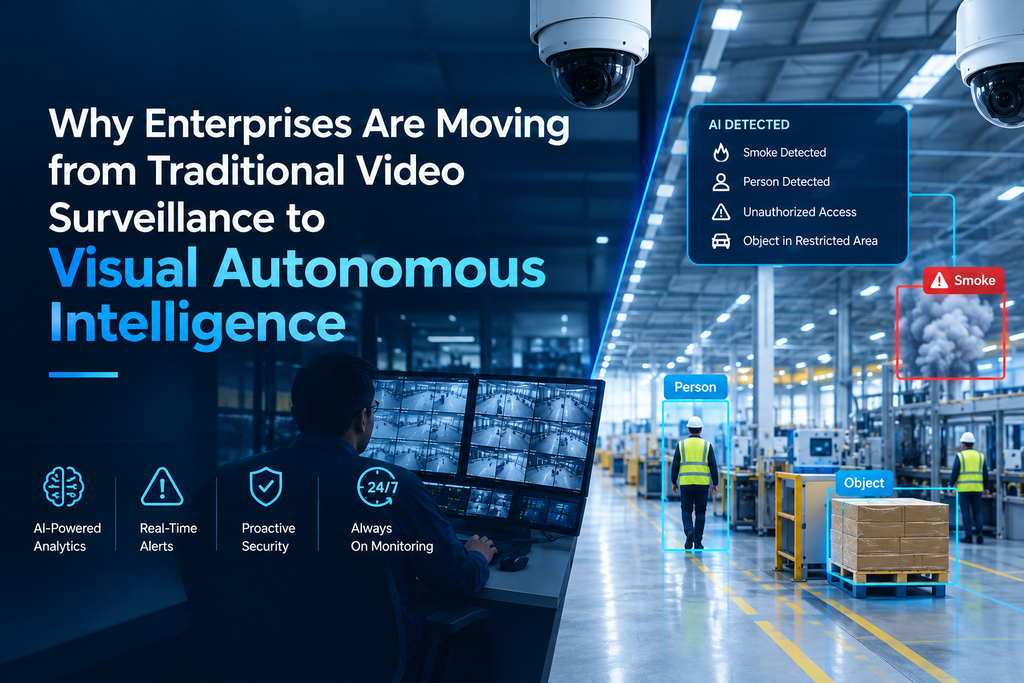
Traditional video surveillance has long been a critical part of enterprise security. Cameras are installed across offices, factories, warehouses, retail spaces,campuses and other facilities to monitor activities and protect assets. However, conventional surveillance systems largely depend on humans to watch video feeds, identify incidents and decide what action to take.
As enterprises become more complex, this approach is no longer enough.
Visual Autonomous Intelligence (VAI) is changing how organizations use their existing camera infrastructure. Instead of simply recording what happened, VAI continuously analyzes visual data, identifies risks, generates intelligent alerts and helps enterprises respond faster.
What Is Visual Autonomous Intelligence?
Visual Autonomous Intelligence is an AI-powered approach that enables cameras and video systems to understand what is happening in real time and support automated decision-making.
Unlike traditional CCTV surveillance, which primarily captures and stores video, a Visual Autonomous Intelligence platform uses artificial intelligence, computer vision, edge computing, and analytics to interpret activities and identify important events.
This allows enterprises to move from “watching video” to “understanding what is
happening.”
For example, an intelligent visual system can identify situations such as:
- Unauthorized access
- Intrusion into restricted areas
- Fire and smoke indicators
- PPE violations
- Unsafe workplace behavior
- Crowd formation
- Suspicious activities
- Vehicle and traffic-related incidents
- Operational process deviations
- Camera or system health issues
The objective is not simply to generate more alerts. It is to provide relevant, actionable intelligence that helps teams detect, decide and respond.
Why Is Traditional Video Surveillance No Longer Enough?
Traditional surveillance creates a large amount of video data, but most of that data remains passive. Security teams may have hundreds or thousands of cameras operating simultaneously.Monitoring every feed continuously is difficult, and human operators can miss important events because of fatigue, distraction, or information overload. Traditional systems also tend to be reactive. An incident occurs, someone notices it, and the team investigates the recorded footage after ward.This creates a significant gap between event occurrence and response.Modern enterprises need systems that can identify critical events as they happen rather than depending entirely on manual monitoring.
From Video Recording to Real-Time Visual Intelligence
One of the biggest changes introduced by Visual Autonomous Intelligence is the ability to convert video into actionable information.Instead of requiring an operator to continuously watch multiple screens, AI-powered video analytics can analyze camera feeds in real time. When a predefined risk or unusual activity is detected, the system can generate an alert and provide relevant information to the responsible team.This can help organizations reduce detection time and improve operational awareness.
For example, in a manufacturing facility, a traditional camera may record an employee entering a restricted zone. A VAI platform can identify the unauthorized entry, trigger an alert, and help security personnel respond immediately. This transition from recording → monitoring → understanding → action represents a
major evolution in enterprise surveillance.
How Visual Autonomous Intelligence Helps Enterprises
1. Faster Threat Detection
AI-powered visual analytics can continuously monitor camera feeds and identify
predefined risks in real time. This can significantly reduce the time required to detect
security, safety, and operational incidents. Faster detection can lead to faster response and potentially reduce the impact of an incident.
2. Reduced Dependence on Manual Monitoring
Human monitoring remains valuable, but relying entirely on people to watch hundreds of video feeds is inefficient. VAI works as an intelligent layer that continuously analyzes visual information and highlights events that require attention.
This allows security and operations teams to focus on high-priority incidents instead
of watching screens continuously.
3. Better Workplace Safety
Visual intelligence can help organizations identify safety-related conditions such as
missing protective equipment, unauthorized access to hazardous areas, unsafe
movement, or unusual crowd behavior.
By detecting these conditions earlier, enterprises can take preventive action rather than waiting for an accident to occur.
4. Turning Existing Cameras into Business Intelligence Assets
Enterprises do not necessarily need to replace their entire camera infrastructure to
adopt intelligent surveillance. Modern Visual Autonomous Intelligence platforms can work with existing camera networks and add an intelligence layer over the available visual data. This makes existing surveillance infrastructure more valuable by transforming cameras from passive recording devices into sources of real-time business intelligence.
5. Improved Operational Visibility
Visual intelligence is not limited to security Enterprises can use visual data to understand operational processes, monitor facilities, identify bottlenecks, and improve compliance. This makes VAI relevant to security teams, facility managers, operations leaders, safety teams, and enterprise decision-makers.
Why Enterprises Are Moving Toward Autonomous Intelligence
The growth of AI, IoT, edge computing, and connected enterprise systems is changing expectations around surveillance. Enterprises increasingly want systems that can do more than collect data. They want technology that can analyze information, identify patterns, prioritize events, and support faster decisions.
This is where Visual Autonomous Intelligence becomes strategically important.
A VAI platform can create a continuous intelligence cycle:
Detect → Analyze → Decide → Respond
Instead of treating surveillance as an isolated security function, enterprises can
connect visual intelligence with broader operational workflows.
The Future of Enterprise Video Surveillance
The future of enterprise surveillance is moving beyond cameras, monitors, and storage. As organizations adopt AI-driven technologies, visual intelligence is becoming an important component of modern enterprise infrastructure. Businesses can use their existing visual data to improve security, safety, operational efficiency, and decision making.
Visual Autonomous Intelligence transforms surveillance from a passive recording
system into an active intelligence platform.
For enterprises looking to modernize their security and operational infrastructure, the
key question is no longer simply:
“How many cameras do we have?”
The more important question is:
“What intelligence can our cameras provide?”
Platforms such as XEye360 are designed around this shift, helping enterprises
transform existing camera networks into intelligent systems capable of detecting risks, generating actionable insights, and supporting faster responses.
Frequently Asked Questions About Visual Autonomous Intelligence
What is Visual Autonomous Intelligence?
Visual Autonomous Intelligence is an AI-driven technology that analyzes video and visual data in real time to detect events, identify risks, generate insights, and support faster decision-making.
How is VAI different from CCTV surveillance?
Traditional CCTV primarily records and displays video for human monitoring. VAI uses artificial intelligence and computer vision to analyze video automatically and identify events that require attention.
Can Visual Autonomous Intelligence work with existing cameras?
Yes. Depending on the platform and camera infrastructure, VAI solutions can integrate with existing surveillance networks, allowing enterprises to add AI-powered intelligence without necessarily replacing all their cameras.
Where can Visual Autonomous Intelligence be used?
VAI can be used across manufacturing plants, warehouses, corporate offices, retail environments, healthcare facilities, educational institutions, transportation facilities, data centers, and large enterprise campuses.
Does VAI replace security personnel?
No. VAI is designed to support security and operations teams by continuously analyzing visual data and highlighting important events. Human teams can then make informed decisions and take appropriate action.
Conclusion
Traditional video surveillance helped enterprises see what was happening. Visual Autonomous Intelligence helps them understand what is happening and respond faster.
As organizations manage larger facilities, more cameras, growing security requirements, and increasingly complex operations, passive surveillance alone may not provide the visibility they need.
The next generation of enterprise surveillance is therefore moving toward AI powered video analytics, real-time visual intelligence, autonomous detection, and intelligent response.
For enterprises, the opportunity is significant: transform existing camera infrastructure into a powerful source of real-time intelligence, operational visibility, safety improvement, and faster decision-making.
Detect. Decide. Respond.
Leave a Reply