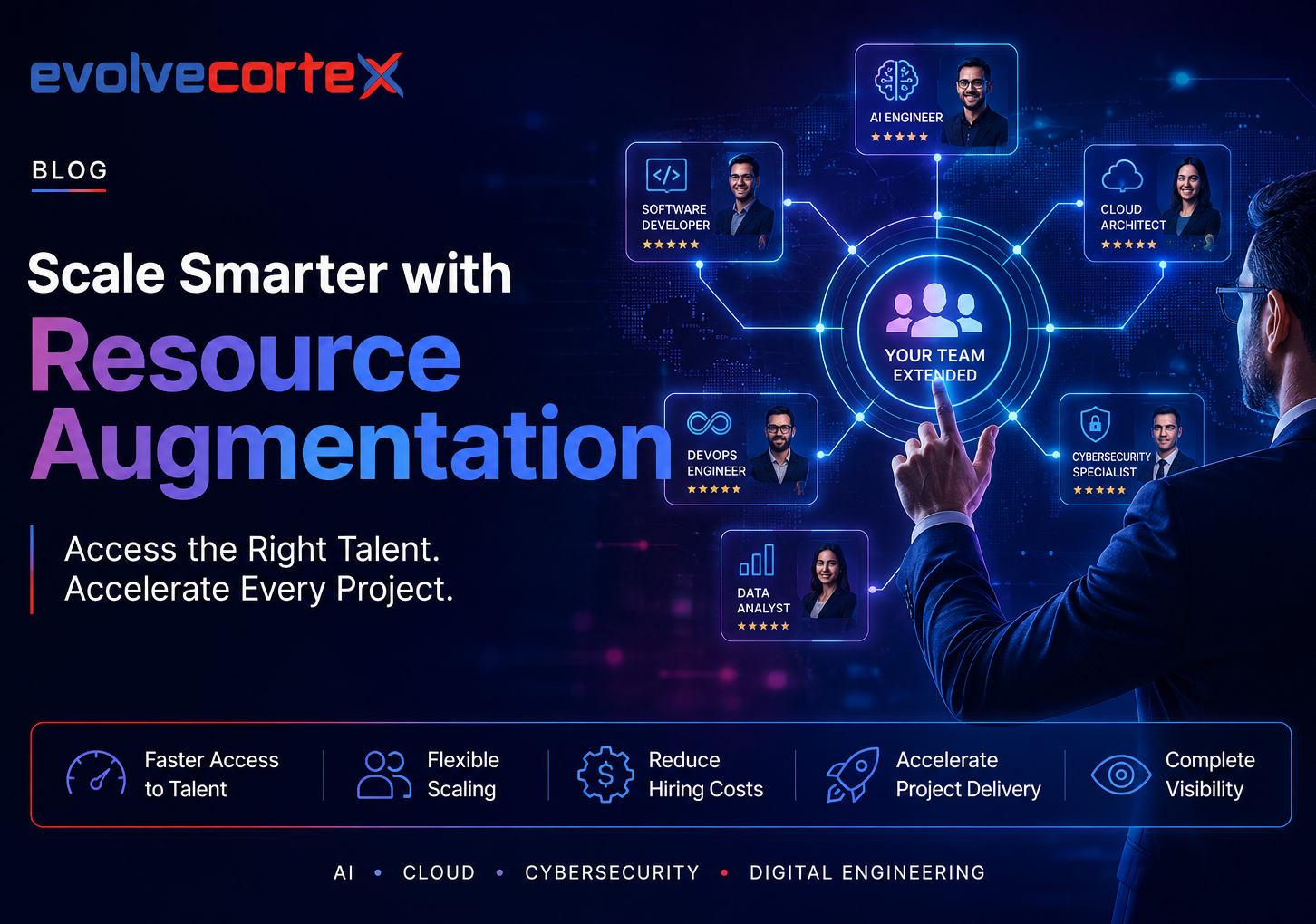


Growth exposes a business’s weakest seam faster than anything else. Revenue climbs,client demands multiply, and suddenly the team that felt “just right” six months ago isstretched thin in exactly the areas that matter most. Resource augmentation — bringing in external specialists who work inside your existing team rather than as a separate outsourced unit — has become one of the most practical answers to that pressure. Here’s why it works, and how to use it well.
The Growth Trap: Too Big to Stay Small, Too Small to Hire Freely
Every growing business hits a version of the same wall. You’ve outgrown what your current team can handle, but you haven’t outgrown the uncertainty that makes big hiring commitments risky. Committing to five new full-time salaries based on this quarter’s momentum is a bet — one that’s expensive to lose if momentum slows.
Resource augmentation removes the bet. It lets a business add real capacity and real expertise sized to today’s need, without pretending to know exactly what headcount will look like a year from now.
1) It Turns Fixed Costs into Flexible Ones
Every full-time hire is a fixed cost — salary, benefits, equipment, office overhead — that exists whether or not there’s a full year of work to justify it. Augmented resources convert that fixed cost into a flexible one. A business pays for expertise during the weeks or months it’s actually needed and nothing beyond that. For growing companies operating on tighter margins while they scale, this flexibility often makes the difference between a healthy runway and a strained one.
2) It Closes Skill Gaps on the Timeline the Business Actually Has
Growth rarely waits for a hiring process to finish. A new enterprise client might require security compliance expertise the team doesn’t have this month, not in three months once recruiting wraps up. Augmented talent can typically start within days, because the vetting and sourcing work has already been done by the augmentation partner. That speed is often the single biggest strategic advantage over traditional hiring.
3) It Preserves Management Control
A common misconception is that bringing in outside help means giving up control of thework. Resource augmentation is built to avoid exactly that. Augmented specialists report into the business’s own managers, follow its own processes, and work inside its own tools — they function as embedded team members, not as an external vendor delivering a black-box result. The business stays fully in the driver’s seat.
4) It Expands the Talent Pool Beyond Local Hiring
Growing businesses competing for senior technical or specialized talent are often competing against every other company in their city for the same small pool of candidates. Resource augmentation removes that geographic ceiling, giving access to specialists anywhere — which matters enormously for hard-to-fill skills like cloud architecture, data science, or niche compliance work.
5) It Reduces the Cost of Getting a Hiring Decision Wrong
Full-time hiring mistakes are expensive to unwind — severance, morale impact, lost ramp-up time, and the cost of starting the search over. Augmentation engagements are structured with defined scope and timelines from the outset, so if a need turns out to be smaller, shorter, or different than expected, adjusting course is far less disruptive than reversing a permanent hire.
6) It Protects the Core Team’s Focus
When growth-stage teams get overloaded, the usual result is that the highest performers get pulled into firefighting instead of the strategic work that made the business grow in the first place. Augmented staff can absorb the surge work — a product launch, a migration, a compliance deadline — freeing the core team to stay focused on what only they can do.
Where Resource Augmentation Fits Best
It’s most valuable for growing businesses when
- A skill is needed for a defined project, not permanently
- Workload has spiked faster than the hiring pipeline can respond to.
- The business wants to test a new capability before building it in-house.
- Budget needs to stay variable rather than locked into fixed salaries.
- A deadline can’t wait for a multi-month recruiting cycle.
Making It Work: A Few Practical Guardrails
Resource augmentation delivers on its promise only when it’s implemented well.
Businesses that see the strongest results tend to:
- Define the exact skill gap and outcome before searching for a partner, rather than augmenting generically
- Fully integrate augmented staff into internal communication channels and documentation, not keep them at arm’s length
- Set clear scope, timelines, and success criteria upfront
- Treat the arrangement as genuinely flexible — scaling capacity up or down as the actual workload dictates.
Conclusion
For growing businesses, the strategic value of resource augmentation isn’t just cost savings — it’s the ability to match capacity and expertise to real-time need, without locking in long-term commitments before the future is clear. It gives growing companies the agility of a startup with the specialized capability of a much larger organization, which is precisely the combination that sustainable growth requires.
Frequently Asked Questions
- What is resource augmentation?
Resource augmentation is a flexible staffing model where businesses add external
professionals to their existing teams to address specific skills, project requirements, or temporary workforce needs.
2. Why is resource augmentation useful for growing businesses?
It helps growing businesses access specialized talent, increase project capacity,
address skill shortages, and respond to changing technology requirements without
relying entirely on permanent hiring.
3. What is the difference between resource augmentation and outsourcing?
With resource augmentation, external professionals generally work as an extension of the client’s existing team. Outsourcing typically involves an external provider managing an entire project, process, or business function.
4. Which professionals can be hired through resource augmentation?
Businesses can augment teams with software developers, AI engineers, cloud
specialists, cybersecurity professionals, UI/UX designers, QA engineers, DevOps
specialists, data engineers, and other technical experts.
5. Can startups use resource augmentation services?
Yes. Startups can use resource augmentation services to access specialized skills,
accelerate product development, and scale technology teams while maintaining
flexibility in workforce planning.